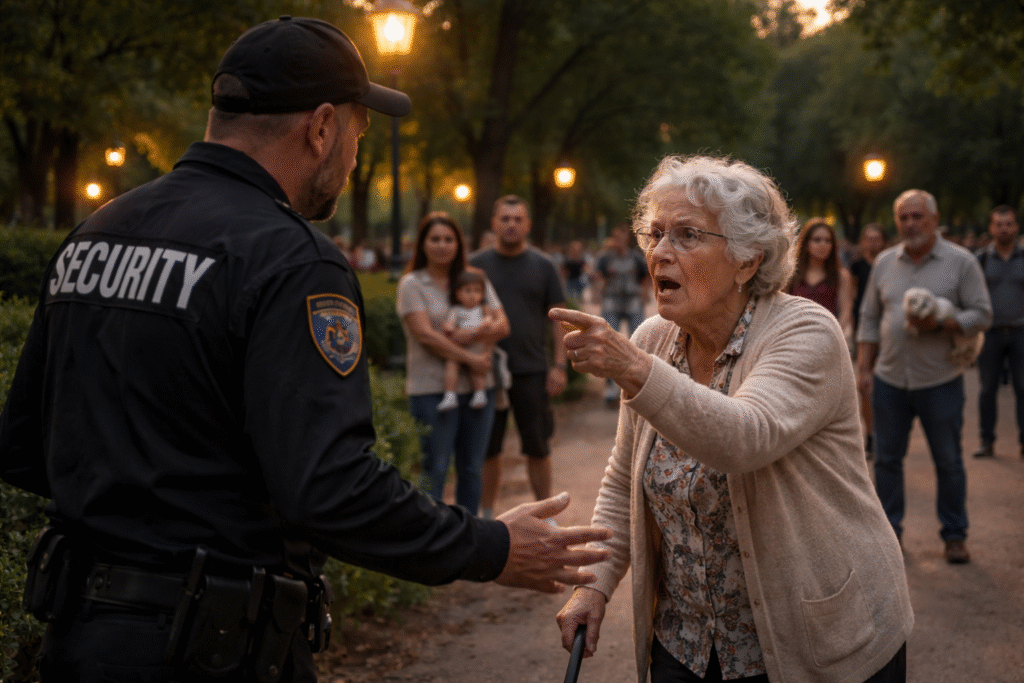
Elvira didn’t raise her voice, but her sentence landed like a stone in still water: “Five minutes… that’s exactly how long it took my husband to die, waiting for someone to decide whether his life fit inside a rulebook.” The guard opened his mouth and nothing came out. A jogger swallowed. The sea breeze kept moving, but it didn’t sound the same anymore.
Elvira adjusted the bag of bread on her knees, like someone arranging a memory. “You’re not a bad man,” she said, looking at him without hate. “You’re just trained to move people, not to see persons.” That precision hurt more than an insult. At the entrance, a mother squeezed her child’s hand, as if afraid the world could suddenly turn cold.
The guard tried to regain control with his professional tone. “Ma’am, I’m sorry, but…” The word “but” hung there. Elvira pointed at her leg, her breathing held tight, and added: “If I stand up now, I’ll fall. And if I fall, someone will have to decide whether to help me up… or whether that also breaks the rules.”
A man in a cap, who until then had watched from a distance, stepped forward. He had the look of someone who has seen too many goodbyes. “I can carry her,” he offered. The guard cut him off: “That’s not allowed.” Elvira gave a faint, tired smile. “Is helping not allowed… or is it not allowed for you to see it?”
The young woman who had offered to call transportation took out her phone, but didn’t dial. Instead, she opened the camera. “This isn’t going to stay here,” she murmured, and the glow of the screen seemed to switch on another kind of light. The guard stiffened, aware that authority changes when there are witnesses who don’t look away.
Elvira leaned forward, as if confessing something she’d kept for decades. “I worked thirty-one years at city hall,” she said. “Not at a nice desk. In the department where the papers arrive that nobody wants to read.” Several people glanced at each other. The guard frowned. “And what does that have to do with anything?” he blurted, too fast.
“That I know how the signs get written,” she replied. “And I also know how excuses get invented when the sign isn’t enough to justify cruelty.” A hard silence settled in. The cyclist, who had only been frowning before, let out air through his nose, offended. The quiet couple moved a little closer, as if the bench were a stage.
The guard swallowed. His hand went to the radio, searching for backup. “Central, I have a situation…” His voice cracked on “situation.” Elvira raised her palm, asking for calm, not permission. “I don’t need a scandal,” she said. “I need to sit until the pain eases. And I need you to remember your name before your title.”
An elderly woman with white hair, walking with a cane, stopped beside the bench. She looked at the guard and then at Elvira. “I hurt too,” she said, without drama. “Is today the day you throw all of us out?” The air filled with something new: not anger, but shared shame. And shame, when it’s shared, becomes action.
The guard looked around and saw what he hadn’t been seeing: determined faces, phones held up, a ring of people who weren’t going to move out of fear anymore. His eyes hardened—not from cruelty, but from fear of making a mistake in front of everyone. And Elvira, gentle but firm, delivered the final blow: “If you want, I can tell you which article they forgot to update.”
Central replied over the radio in a neutral voice: “Proceed with standard closure.” It was the perfect phrase to hide behind. The guard gripped the device as if he could squeeze an escape out of it. Elvira, meanwhile, seemed calmer the more the tension grew. “Standard closure was made for grass, not for people,” she said, and someone behind her whispered, “Exactly.”
The man in the cap took a breath. “My name is Marco,” he said, looking at everyone like someone calling a group together. “I work nights at the dock. My mom is the same age as her. If someone falls, it’s not an ‘incident’—it’s a life.” His voice wasn’t heroic; it was ordinary. That’s why it worked. People nodded, and the circle tightened, silent, firm.
The guard stepped toward the bench, trying to recover authority through proximity. “Ma’am, if you stay, they’ll make me report it.” Elvira didn’t flinch. “Report it,” she answered. “Write my full name: Elvira Santillán. And write that I asked for five minutes so I wouldn’t fall. If your report can survive being read out loud, go ahead.”
The young woman with the phone spoke for the first time with clarity: “What’s your name, officer?” It didn’t sound aggressive. It sounded exact. The guard hesitated, because understanding the power of a simple question is the beginning of losing it. “I don’t have to…” he started, and stopped. Elvira finished it, almost tenderly: “Don’t be afraid. We all have a name before a uniform.”
At the edge of the park, an elegant man with headphones removed one earbud and listened. He wore an expensive jacket, but the gesture was human. He came closer, took in the scene, and asked, “What’s going on?” Marco answered: “They want to kick her out like she’s trash.” The elegant man looked at the guard and, without raising his voice, said: “Is that happening here?”
The guard straightened up, recognizing a different kind of influence. “Sir, the park is closing.” The elegant man pointed at the bench and Elvira’s leg. “And she isn’t doing anything,” he said. “She’s just sitting.” Then he looked around and saw the phones. “This is going to escalate,” he added, like a diagnosis. The guard felt the weight of that word.
Elvira let out a long sigh, like someone choosing to reveal the card no one expects. “I wrote the first version of this regulation, years ago,” she said. “And I also drafted the medical-emergency exception clause.” The guard froze. “That clause exists for moments like this,” she continued. “But it benefits many people to pretend it doesn’t.”
Central crackled again, impatient: “Situation resolved?” The guard looked at Elvira, then at the crowd. The right answer was no longer technical. It was moral. He swallowed. “Not yet,” he said, and he heard himself as if he were someone else. Elvira smiled slightly—not in victory, but because the world had just shifted a millimeter.
A distant siren cut through the air. It wasn’t for her—at least not yet. But the sound triggered fear. The mother hugged her child. Marco clenched his fists. The elegant man frowned. The guard muttered, “They’re going to send someone.” And Elvira, as if she could see the future in the trees’ shadows, replied: “Let them come. It was about time.”
Then the young woman showed her screen: the video was live. Comments flew by. People asked for the park’s name. Others offered help. One message stood out: “I’m a lawyer. Document everything.” The guard saw the livestream and his face changed—he understood he no longer controlled the story. Elvira looked at him and said: “Now you see… the sign is small, isn’t it?”
Part 4
A patrol car arrived—but not with the aggression everyone feared. It arrived cautiously, because digital noise weighs more than a siren. A young officer stepped out, alert-eyed, along with an older superior with the face of long fatigue. The officer looked at Elvira and then at the guard. “Explain to me exactly,” she asked, and the circle of people fell silent to listen.
The guard spoke first, fast, defending his ground: “Park closure. Person refuses to leave.” Elvira lifted an eyebrow—no outrage, just correction. “I’m not refusing,” she said. “I’m waiting for the pain to ease so I don’t fall. That’s different.” The officer looked at her leg. The older superior scanned the crowd. It was a problem with cameras and conscience.
Marco stepped forward, respectful. “If she falls, she gets hurt,” he said. “And if she gets hurt, you’ll have a worse report.” The older superior looked at him like someone calculating risk. Elvira interrupted with something unexpected: “I’m not here to ask you for a favor. I’m here to ask for coherence.” Breath was held around the circle. Coherence rarely shows up in places of authority.
The elegant man introduced himself: “I’m on the neighborhood committee.” He didn’t give his name at first, as if his position shouldn’t carry weight—but it did. “I’m watching this live,” he added, gesturing toward the young woman’s phone. “If there’s a medical exception clause, apply it. If there isn’t, invent humanity. The city won’t collapse over five minutes.”
The young officer crouched to get on Elvira’s level. “Do you need an ambulance?” Elvira shook her head calmly. “I need time. And I need someone to stop treating me like an object that’s out of hours.” The officer took a slow breath and looked at the superior. It was the look of “I know what’s right.” The superior hesitated, because what’s right often collides with fear of punishment.
Then Elvira pulled a folded paper from her coat pocket. It wasn’t a glossy official document; it was an old, yellowed copy with handwritten notes. “Here,” she said, holding it out. The superior took it and read. His jaw tightened. The officer leaned in. The guard went pale. It was real: the clause was there, with old signatures.
“Where did you get this?” the superior asked, suspicious. Elvira smiled sadly. “From my life,” she answered. “From the same place the city keeps its secrets: in forgotten drawers.” The superior looked at the header and recognized historic names. It wasn’t a trick. It was proof. The crowd felt the shift: it was no longer opinion versus authority; it was truth versus habit.
The guard tried to save himself: “Nobody trained us on that.” Elvira looked at him the way you look at someone who can still choose. “Then today you learn,” she said. “Because the worst thing isn’t not knowing. The worst thing is not wanting to know.” The young officer nodded slowly. The superior handed the paper back, exhaled, and ordered in a dry voice: “She stays. Document it as a medical exception.”
People exhaled, as if the park had regained oxygen. But Elvira didn’t celebrate. She looked at the young woman livestreaming and said: “Don’t stop yet.” The young woman hesitated. Elvira added: “This doesn’t end with them letting me sit. It ends when no one has to be humiliated just to rest.” The superior frowned, uncomfortable. Elvira was aiming higher than her own bench now.
The elegant man stepped closer. “Mrs. Elvira… what do you want?” Elvira tightened her grip on the bag of bread. “I want a chair with a backrest near the entrance tomorrow when the park opens. And a number people can call for help. And a notice that says: ‘If you’re in pain, we take care of you.’” The guard stared, confused. It was a simple request that exposed decades of indifference.
The young officer spoke softly: “That’s not up to us.” Elvira lifted the paper again. “It’s up to everyone,” she replied. And then she said the line that split the scene in two: “I didn’t come for five minutes. I came because today someone was going to learn… or be exposed.” The livestream filled with messages. And the superior, unwillingly, understood the city had just woken up.
Elvira stayed seated, but the bench was no longer just a bench; it was a place where people had decided to look each other in the face. Marco stood beside her like a silent shield. The mother approached with her child, who held out a bottle of water without embarrassment. Elvira accepted it with a small smile, and that tiny gesture felt like repair.
The guard didn’t move, but he no longer looked like the owner of the park. He looked like someone who had just remembered he, too, will age. He stepped closer and, without announcing it, lowered his voice. “I’m sorry,” he said, almost inaudible. Elvira looked at him and didn’t forgive him with pretty words; she forgave him with an instruction: “Tomorrow, when you see someone tired, don’t ask about hours. Ask their name.”
The older superior called in on the radio, this time to document the exception and request a review of protocols. It sounded bureaucratic, but it was a real change: he was putting in writing what had previously been denied. The young officer took notes and, as she did, looked at Elvira with genuine respect. Elvira didn’t want respect as a prize. She demanded it as the standard, and that shifted everyone present.
The elegant man from the neighborhood committee asked the young woman for her contact. “I need that video,” he said. “Not to destroy anyone, but so city hall can’t pretend this didn’t happen.” The young woman nodded, her hand trembling from adrenaline. The livestream continued, and thousands of eyes were now inside the park. Silence had become an audience.
Elvira opened the bag of stale bread. Everyone thought it was for her. But she broke off a piece and set it near the path. A bird approached, cautious. “Sometimes you just need someone to leave food where there used to be only hurry,” she said. The line was simple, but it stuck in everyone’s mind—because the park, suddenly, felt like a mirror of the whole city.
Marco asked quietly: “Why did you expose yourself like this?” Elvira looked at him, and for the first time her voice cracked. “Because I got tired of surviving in silence,” she replied. “Today I saw that guard yelling at me the way they used to yell at my mother. And I understood that if I stayed quiet, I’d be handing that shout down to my grandchildren.” No one knew what to say, and that lack of words was real respect.
The young officer stood and looked at the guard. “Come with me,” she ordered. It wasn’t punishment; it was mandatory conversation. The guard obeyed, but before leaving he turned back to Elvira. “What did you say your name was?” Elvira held his gaze. “Elvira Santillán,” she answered. And added: “But today my name doesn’t matter. What matters is that you remember yours when you’re about to forget someone else’s.”
Minutes passed. The pain in her leg eased like a slow tide. Elvira breathed better and leaned on Marco to stand. It wasn’t theatrical. It was human. The mother and child said goodbye. The quiet couple smiled. The cyclist, who had arrived frowning, removed his helmet and murmured, “Thank you.” Elvira nodded, like someone signing an invisible agreement.
On her way out, Elvira stopped in front of the park-hours sign. She looked at it like an old enemy that no longer scares her. The young woman was still recording. Elvira touched the edge of the sign and said: “This is useful… but it isn’t sacred.” The sentence, short and exact, exploded across the livestream—because it captured what everyone had felt without knowing how to name it.
That night, the video went viral. But the important part wasn’t the virality; it was the concrete reaction. The next day, a councilwoman requested reports. A supervisor ordered training to be reviewed. And the neighborhood committee announced a proposal: benches with backrests, an assistance protocol, and a direct line for emergencies. It wasn’t a miracle. It was public pressure turned into local policy—the adult form of justice.
The guard, for his part, wasn’t fired immediately, as some comments demanded. He was reassigned and required to undergo training, and that angered those who wanted quick blood. Elvira heard and didn’t celebrate. “If they fire him, they learn to hide,” she said. “If they educate him, they learn to change.” It was an uncomfortable stance, but smarter. Punishing one person can clean the screen; fixing the system changes the street.
A week later, Elvira returned to the park. Not as a challenge—out of restored habit. There was a chair with a backrest near the entrance, still smelling of fresh paint. There was a small sign with a help number. And there was something better: the guard didn’t shout. He approached, met her eyes, and said: “Good afternoon, Mrs. Santillán. Do you need to sit for a moment?” Elvira took a deep breath. The park, at last, felt like a refuge.
Elvira sat down, took out bread—fresh this time—and shared it with passersby. A teenager stopped, hesitated, and then accepted a piece. “My grandma lives far away,” he said. Elvira looked at him and replied: “Then today it’s your turn to remember her here.” The boy smiled. And in that moment, the real climax wasn’t the confrontation—it was the slow rebuilding of something simple and lost.
When the sun began to fall, the same hours sign was still there. The park, technically, was closed. But no one stood up in fear. The young officer rode by on a bicycle and waved. Marco appeared in the distance and lifted a hand. The mother walked by with her child and winked at Elvira. And Elvira, without drama, said one last thing, looking at the now-dark camera: “Close the park—but don’t close the heart.”
If you want, I can also translate Part 1 the same way, or adjust this to a stricter structure (fixed word-count per paragraph, exact number of paragraphs per section) while keeping the tone and rhythm.