Teresa held the document as if it were a candle lit against the wind. She didn’t wave it. She didn’t use it to humiliate. She simply showed it, with that calm that isn’t born of weakness, but of having survived too many storms. Michael tried to laugh, but the laugh came out broken, like a poorly shut door.
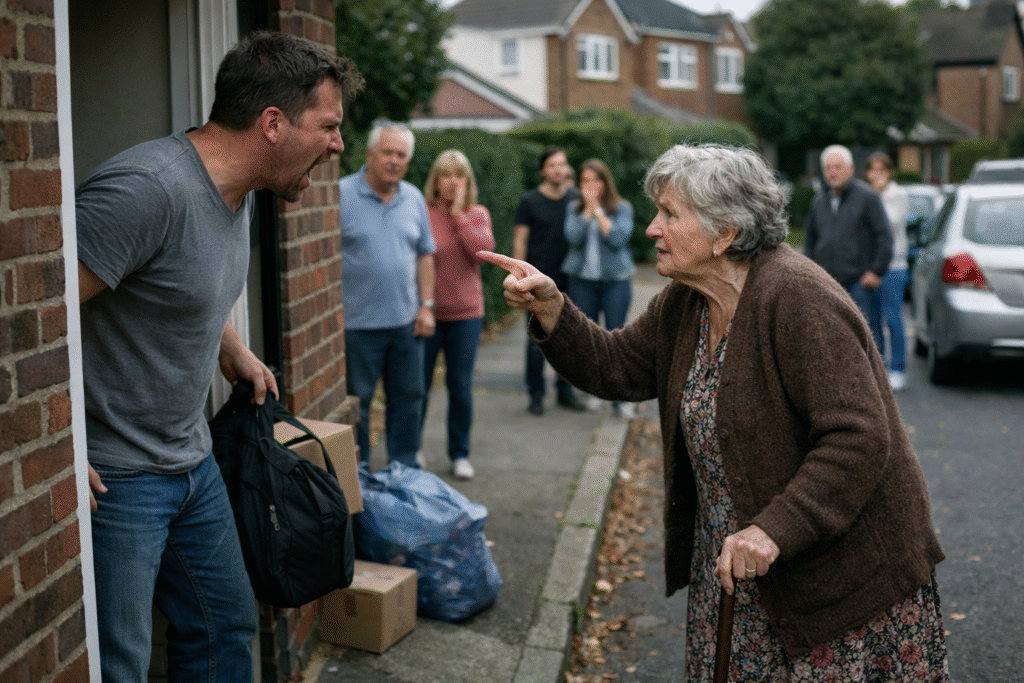
The neighborhood, which minutes earlier had been the noise of gardening and greetings, turned into an open-air courtroom. You could hear the hum of an air conditioner in the distance, the snap of a hose, and the held breath of several people. Teresa looked at the woman with the red mailbox and nodded, giving thanks without words.
Michael took a step toward her, the sale papers clenched as if they were a shield. He said the lawyers were ready, that everything was legal, that the house was his. Teresa didn’t argue with that sentence. She asked something else, simple and lethal: who had explained to him what “life estate” meant before a notary.
The word “notary” changed the color of the scene. A man mowing the lawn shut off the machine. A teenager stopped recording for a second, as if reality were outpacing the video. Michael looked around, irritated, and tried to take back control with volume. But the voice was no longer the center; the document was.
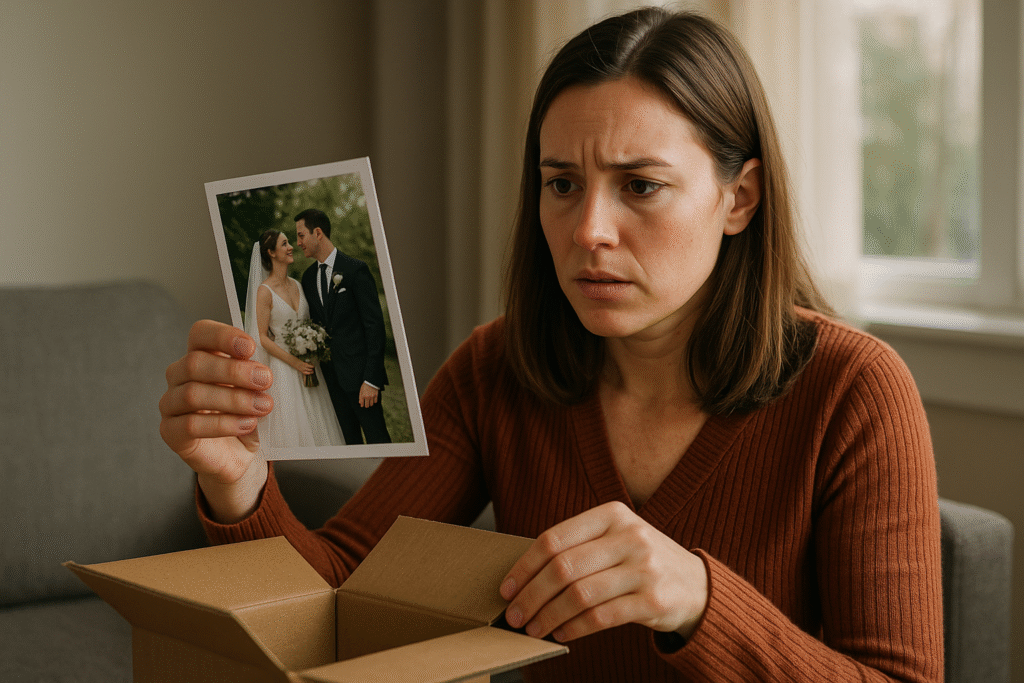
Teresa opened the box of photographs. She didn’t do it to cry. She pulled out a black-and-white image: she and her husband in front of that same door, young, smiling with the paint still fresh. She held it beside the document. Two different proofs, the same message. The house wasn’t just brick; it was memory, work, and signed promises.
Michael said, “don’t do this to me.” It was the first thing that sounded like a confession. Teresa tilted her head, like someone listening to a child making excuses. She asked if he remembered the day she sold her jewelry so he could pay for his first college. Michael swallowed. The neighbors glanced at each other. No one interrupted.
A neighbor, Mrs. Klein, spoke cautiously. She said she remembered Teresa’s surgery, the fear of losing her, the rushed visits, the signatures. She said she had seen Michael take her to the bank. Michael burned her with his eyes. Teresa didn’t need witnesses, but every outside word was a brick reinforcing her dignity.
Michael tried the low blow: “you’re getting confused, Mom.” Teresa smiled without joy. That phrase, so often used to silence the elderly, sounded to her like a door closing from the inside. She pulled out her old phone and opened a saved message. She didn’t read it yet. She only said she’d kept it in case one day she needed to remember exactly who promised what.
The silence was so thick it felt like the entire street had swallowed the sunset. Teresa looked at Michael and, for the first time, let a line fall that was neither plea nor reproach. It was a serene sentence: “You’re not kicking me out. You’re giving yourself away.” Michael blinked fast, as if the world’s focus had shifted.
From a nearby house came a man in a work shirt with hands stained with paint. It was Mr. Patel, who almost never got involved in anything. He came closer, looking at the document, and said his sister was a paralegal. He didn’t offer a fight. He offered certainty: that clause prevented an eviction. Michael opened his mouth, but he couldn’t find a clean argument.
Teresa didn’t raise her voice, but she did lift her gaze, like someone deciding never to bow her head again. She said she had allowed the title change out of trust, because a son is supposed to protect, not prey. “I confused blood with loyalty,” she said. The neighbors felt the blow, because that truth doesn’t belong to only one family.
Michael, cornered, tried to negotiate in front of everyone. He suggested Teresa leave “temporarily” for a small apartment, “for comfort.” Teresa pointed at the suitcase lying there and the word “temporarily” collapsed into ridicule. “Comfort doesn’t start with screaming,” she answered. And then she looked at the suitcase as if she were looking at the future he wanted to force on her.
The son talked about his debts as if they were a moral excuse. He said the business had collapsed, the bank was after him, the sale was the only way out. Teresa didn’t mock him. She only asked how much he had gambled from that house without telling her. Michael frowned. And the neighborhood, without meaning to, began adding the pieces: sale, haste, suitcase, public shame.
Teresa asked for one thing no one expected: that he say out loud the date of the notarized signature. Michael hesitated. He looked at his papers. That pause was thunder. Teresa said the date herself, exact, as if it were tattooed inside her. “That day I was on morphine,” she added. “And you knew it.” Someone let out a “My God” under their breath.
Michael denied it—fast, too fast. He said she was conscious, that she understood, that it was her own will. Teresa didn’t argue. She raised the phone and, at last, read the saved message. It was from Michael: “Sign, so I can handle everything while you recover. I promise it’s only for security.” The word “promise” hung over the street like a knife.
The woman with the red mailbox covered her mouth. A child dropped a ball that bounced on its own, indifferent to the emotional gravity. Michael, red-faced, tried to snatch the phone. Teresa pulled it back without violence, with the skill of someone who has learned to protect herself without striking. “That’s evidence too,” Mr. Patel said, no longer in a friendly tone.
Teresa took a deep breath and put the phone away slowly. She wasn’t enjoying this. She was choosing. She said she wasn’t going to expose him more than necessary, but she also wasn’t going to let them bury her alive to pay for other people’s mistakes. Michael clenched his teeth. His pride collided with a simple reality: the entire street had heard the promise.
A car rolled by slowly, as if the driver could smell the drama. Teresa looked up at the sky. “I didn’t come to fight for a house,” she said. “I came to fight for my place in the world.” Michael spat an insult, and that made everything worse. Because when someone loses the argument, they take refuge in poison—and poison always leaves a mark.
Teresa asked someone to call the police, not to punish, but to document the attempted eviction. No one moved for a second, afraid of being “the one who gets involved.” Then the teenager, the one who had been recording, stepped forward and dialed. She did it without dramatics. Like justice was a school assignment. Michael looked at her as if it were betrayal.
While they waited, Teresa sat on the step, the box in her lap. That image—an elderly woman sitting in front of her own door—was a living photograph no one wanted to forget. Michael paced back and forth. The sale documents fluttered in his hand, but they no longer looked like power; they looked like printed desperation.
Teresa said something even quieter: that she didn’t hate her son. That would be easy. What hurt was having raised him to believe love could be turned into a bank guarantee. Michael stopped. The neighborhood felt the line like a stone thrown into a pond. The ripples touched everyone: sons, mothers, debts, silences.
A patrol car arrived. Two officers got out with that mix of routine and alertness. Teresa stood up slowly and spoke first, clearly. She explained the clause, showed the document, mentioned the attempted eviction, showed the message. The officers listened. Michael kept interrupting, but every interruption sank him a little more. Calm, again, was the weapon.
One of the officers asked to see identification and asked who lived there. Teresa answered without hesitation: “Me, for forty years.” Michael said: “I’m the owner.” The officer didn’t pick a side by emotion; he picked by paper. He looked at the clause and nodded. He said he couldn’t evict her. Michael exhaled as if he’d been hit.
Teresa didn’t smile. She didn’t celebrate. She only asked that the incident be recorded. Michael protested: that it was “a family matter.” The officer answered something that cut the air: “When you make it public and there’s an attempt to force someone out, it stops being only family.” The neighbors swallowed. Michael looked around and understood his scene had an audience and a consequence.
Michael, in a lower voice, said they would talk inside. Teresa looked at him the way you look at a smoky room—knowing going in without protection would be dangerous. She said they would talk with lawyers present. She said she was no longer negotiating in secret. That hurt Michael because secrecy was his advantage. Without secrecy, only the truth remained—and the truth didn’t favor him.
Teresa asked to go into her house, and she did. The door closed behind her with a soft, almost elegant click. Michael stood outside for a second, confused, as if he’d forgotten the door could close on him too. The neighbors didn’t clap. Some left in silence. Others stayed because they sensed this was only beginning.
Inside, Teresa set the box on the entry table. She looked at the living room, the curtains, the old painting, the clock still ticking patiently. Everything was the same, but she wasn’t. She went to the drawer where she kept documents and pulled out a folder with old labels. Without knowing it, she had been prepared her whole life for this moment.
Her hand trembled, yes, but her mind was steady. She found tax receipts, repair payments, bills. Proof of residence, of upkeep, of commitment. It wasn’t only a life estate; it was a pattern of life. Michael had tried to reduce her to “a signature.” Teresa was going to restore the story to its real size.
Outside, Michael talked on the phone, hurried. Phrases slipped out: “yeah, but she has a document,” “no, I can’t get her out,” “the whole neighborhood saw it.” Teresa heard him through the window without going closer. There was a mature sadness on her face: it wasn’t money that was breaking him—it was exposure.
Teresa called an old friend, Clara, who had been a nurse and now worked with a community legal clinic. She didn’t beg. She just informed. She said: “Today my son tried to throw me out. I have proof. I need help securing my rights.” Clara didn’t ask for gossip. She asked about safety, documents, schedules. That’s how a real network activates: without theater.
When Teresa hung up, she allowed herself one second of absolute silence. She looked at her husband’s photo and spoke as if he were there: “I’m not going to leave.” It was an intimate promise, not a shout. Outside, the sun finished going down. And in that house, for the first time in a long time, Teresa felt the fear had changed owners.
The next morning, the street looked normal, but it wasn’t. Blinds opened carefully, like eyes trying to hide that they’d been awake all night. Teresa went out to get the newspaper and found, at the edge of the yard, the “For Sale” sign tilted. She straightened it calmly and yanked it out by the roots, the way you tear out a lie.
Michael arrived early, without shouting, with dark circles under his eyes and a rehearsed smile. He brought coffee and a sweet tone that sounded borrowed. He said he wanted to “fix things.” Teresa didn’t move to open the door any wider. She asked him to speak from the porch. The boundary—physical and symbolic—disarmed him. It was the first time his mother put a visible line in place.
Michael said everything had gotten out of hand, that he was stressed, that he “never meant to hurt her.” Teresa looked at him with a compassion that didn’t forgive. She asked why the suitcase had been ready before the argument. Michael lost his breath. The question was simple and, for that very reason, impossible to decorate. Silence exposed him better than any insult.
Teresa invited Michael to sit, but not to come in. They sat like polite strangers. She said she’d spoken with a legal clinic and that any conversation would be documented. Michael smiled less. He said he didn’t want to “turn this into a war.” Teresa answered that he had already chosen war when he chose public humiliation. Now she would choose strategy.
Michael tried an offer: sell the house and give her a “generous” share. Teresa shook her head. It wasn’t a business deal. It was her home. Michael insisted with the argument that he needed to “save his life.” Teresa corrected him without harshness: “Saving your life can’t mean destroying mine.” Michael rubbed his forehead, frustrated, and looked to the street for support.
He didn’t find it. Because the night before he had planted witnesses. Mrs. Klein waved to Teresa from her window, not getting too close, like someone respecting another person’s grief. Michael saw it and lowered his gaze. He understood that in a neighborhood, reputation is a second property: you don’t buy it, you build it. And he had mortgaged it on impulse.
Teresa pulled out a notebook and wrote down the time of the conversation. Michael looked at her with contempt. Teresa explained she learned—late—that love doesn’t replace the record. Michael said that was “overreacting.” Teresa didn’t argue: she asked if it was also overreacting to keep the message where he promised it was “only for security.” Michael squeezed the coffee cup until it almost cracked.
That same day Clara arrived with a folder and a steady presence. She didn’t look like a lawyer; she looked like a firm aunt. She greeted Teresa, ignored Michael’s performance, and asked to see the original notarized document. She reviewed it carefully. She told Michael, without raising her voice, that a life estate wasn’t decoration—it was strong protection. Michael swallowed, annoyed.
Clara asked something that changed the air: whether Teresa had received independent counsel when she signed. Michael tried to answer for her, but Clara stopped him. Teresa told the truth: no. She said she trusted him. Clara nodded, as if she already knew. And then she talked about “undue influence” and “capacity” in a tone that didn’t threaten, but did warn.
Michael stood up, nervous, and said he wouldn’t allow “strangers” to accuse him. Clara looked at him straight: “What’s strange is throwing your mother out with a suitcase.” Michael froze, as if the line had shoved him into a wall. Teresa felt something new: it wasn’t victory, it was relief. Because when someone names abuse, abuse loses its magic.
In the afternoon, Teresa received a letter in the mailbox: notice of intent to sell. It wasn’t final, but it was an attempt to keep moving as if nothing had happened. Clara read it and smiled without joy. She said they would respond formally. Teresa looked at the paper and felt the sting of understanding her son wouldn’t stop out of conscience; he would stop because of limits.
That night, Teresa heard a car stop in front of her house. She saw shadows near the yard. She didn’t go out. She called the patrol not to dramatize, but to prevent. The officers arrived, checked, and found the “For Sale” signpost driven back in, with contact tape. It was a provocation. A message: “I’m still here.” Teresa ripped it out again.
The next day, Clara took Teresa to make a formal statement. Teresa walked slowly, but with dignity. In the waiting room there were other people with similar stories: displaced grandparents, manipulated mothers, families broken by money. Teresa realized it wasn’t a rare case; it was a silent pattern. That understanding didn’t depress her; it lit her up.
Teresa signed documents that reinforced her residency and notified her rights. Clara explained options: an order to stop the sale, a civil suit, the possibility of reviewing the title transfer. Teresa listened without getting lost. She had been underestimating herself for years. Now every legal term was a brick to rebuild herself. It wasn’t revenge. It was survival with method.
When Michael found out, he showed up furious at the clinic entrance. He didn’t shout, but his body did. He said Teresa was ruining him. Teresa looked at him with a sadness that finally had an edge. “You ruined yourself when you decided to use me,” she said. Michael tried to come closer, but a guard stopped him. The scene flipped: now he was the one who couldn’t get in.
That afternoon, at home, Teresa found a drawer with old letters from her husband. She had kept them unread for years, like they were too painful. This time she opened one. In a line, he said: “If one day you’re left alone, remember the house is your refuge, not your chain.” Teresa pressed the letter to her chest. She felt her husband holding her from the past.
The letter gave her an idea. Teresa began searching, among old papers, for an additional document: a family trust almost no one talked about. She vaguely remembered her husband had made arrangements to protect her. When Clara heard that, she turned serious. She said if it existed, it could change everything. Teresa felt a chill: maybe there was an even stronger protection, hidden.
They searched for hours. Teresa opened folders, envelopes, boxes. She found an envelope with the name of a lawyer from twenty years ago. Inside was a summary: a structure that prevented the property from being sold without her consent while she lived. Teresa stared at the paper like someone watching a secret door open inside her own home. Michael wasn’t only wrong; he was trapped.
Clara called the lawyer’s office. The number had changed, but they traced it. They confirmed a file existed and that they could request a copy. Teresa felt a mix of relief and anger: her husband had foreseen this. And she, out of trust, had let Michael handle too much. She didn’t blame herself; she corrected herself. That’s the difference between shame and learning.
Michael, not yet knowing about the trust, tried to speed up the sale. A real estate agent came down the street taking photos from the sidewalk. Teresa went out and told him, firmly, that the property had occupancy rights and ongoing legal matters. The agent turned pale, muttered apologies, and left. Within minutes, Michael’s phone began ringing with uncomfortable questions.
Michael arrived like a storm. He yelled from the yard, careful not to cross the porch. Teresa didn’t go out alone; she went out with Clara. Michael demanded to talk “without lawyers.” Clara answered: “Your mother won’t be alone with you again on property decisions.” Michael insulted Clara. Teresa stepped forward and said: “Don’t speak to her like that in my house.” The line stopped him.
Then something strange happened: Michael broke, but not into remorse. He broke into desperation. He said he was on the edge of losing everything, that he owed money to dangerous people, that the bank was the least of it. Teresa felt real cold. For the first time, the problem stopped being only moral and became security. Clara made a mental note and told Teresa she wouldn’t be alone.
That night, Clara recommended changing locks, installing cameras, alerting trusted neighbors. Teresa agreed without pride. She understood protecting herself wasn’t paranoia when there were concrete signs. The teenager from the video, now more aware, offered to check community cameras if anything happened. Teresa thanked her. The community, which is often gossip, turned into a network when a threat appeared.
Michael sent Teresa messages: he alternated apologies and pressure. “I didn’t mean to,” then “you’re forcing me,” then “you’re selfish.” Teresa didn’t respond impulsively. She saved everything. Each message was a piece showing a pattern. Clara explained that consistency is powerful: when someone manipulates, they leave repeated fingerprints. Teresa began to see those fingerprints like someone learning to read a language.
A week later, the copy of the lawyer’s file arrived: confirmation of the trust and its restrictions. Clara reviewed it carefully and smiled for the first time with genuine relief. “Your husband protected you,” she said. Teresa went still, with small tears—not of sadness, but of recognition. She had been loved with foresight, not only with words.
When Michael found out, he exploded on the phone. He said it was unfair, that his father had “betrayed” him. Teresa answered with a calm that was now steel: “Your father didn’t betray you. He limited you. Because he knew you better than I wanted to accept.” Michael fell silent. That silence wasn’t peace. It was calculation. Teresa felt it the way you feel a door creak again.
That same night, the new camera caught something: an unknown man approaching the mailbox and leaving an envelope. Teresa didn’t touch it until Clara arrived. Inside was an anonymous note: “Tell your son to pay.” Teresa felt the ground tilt. Clara called the police immediately. The problem was no longer only inheritance; it was an outside shadow slipping in through the crack.
The officers took the note, reviewed the footage, asked about Michael. Teresa didn’t defend him. She said what was necessary: that he was in debt, that he had tried to sell the house, that now there were threats. The officers looked at each other seriously. They told Teresa to increase security measures and avoid direct confrontations. Teresa nodded. The story was leveling up.
That dawn, Teresa couldn’t sleep. She sat in the kitchen with a cup of tea, staring at the window. She thought of Michael as a child, his scraped knees, his fears. And then she thought of the suitcase rolling down the steps. She understood something painful: there were two Michaels, and the one of today was choosing which one to obey.
At sunrise, Teresa made a decision: she would not only protect herself, she would stop Michael from destroying others. She called a financial counselor recommended by the clinic and asked for an assessment of Michael’s situation, if he agreed. It wasn’t to save him with money; it was to force him to face reality. Sometimes helping is cutting off the easy road.
Clara warned that Michael might react badly. Teresa knew. But she also knew fear couldn’t run her. She prepared a folder with everything: notarized document, messages, threat note, trust, police reports. It wasn’t a war folder; it was a truth folder. And truth, when organized, becomes a door that can’t be pushed open.
Michael showed up two days later, thinner, with a look that wasn’t only anger. It was panic. He stood in front of the door and, for the first time, didn’t shout. He asked to talk “five minutes.” Teresa, with the chain on and the camera recording, opened only a crack. She didn’t let him in. She told him to talk there. Michael swallowed and agreed, because he no longer had authority.
He said he had made mistakes, that he signed things, that he took loans with absurd interest. Teresa listened without interrupting, as if she were hearing someone confess in a church without an altar. Michael said the people who lent him money didn’t negotiate calmly. Teresa remembered the note. She felt a stab of fear, but she didn’t show it. Shown fear gets used as leverage.
Teresa asked him the central truth: whether he had used the house as collateral without telling her. Michael closed his eyes. He nodded. That silent word was the complete collapse of the disguise. Teresa breathed deep and didn’t shout. She only said: “Then it wasn’t a sale. It was a ransom.” Michael lowered his head. On the street, a car passed slowly. Teresa felt the world watching.
Michael asked Teresa to “help him” by letting him sell. Teresa refused. She told him she had already spoken with authorities because of threats and that any attempt to involve the property would be fought legally. Michael smacked the frame with his palm, frustrated, but held back. Teresa saw something dangerous: when someone holds back fury, sometimes they move it somewhere else. She couldn’t be that place.
Clara arrived shortly after, as if time had called her. Michael tensed when he saw her. Clara asked for specific details: amounts, names, dates. Michael hesitated. Clara didn’t let him dodge. She walked him, with precise questions, into describing a situation that no longer sounded like “bad luck,” but repeated choices. Teresa listened and felt, with pain, that her son had been building a trap around everyone.
Michael said the name of a lender. Clara wrote it down and asked if there were direct threats. Michael said yes, that they gave him “deadlines.” Teresa looked at him with immense exhaustion. “And your plan was to throw me out,” she said, “to hand them my house.” Michael tried to justify it: “it’s all I have.” Teresa answered: “I’m not your thing.”
Clara proposed a path: that Michael accept legal counsel to renegotiate, file bankruptcy if necessary, and cut ties with illegal lenders. Michael laughed bitterly and said it wouldn’t save him. Clara replied that maybe it wouldn’t save him fast, but it would save him clean. Teresa felt that word—clean—was what her family history had been missing.
Michael suddenly asked to speak to Teresa alone. Clara said no. Michael insisted. Teresa, without raising her voice, said: “Whatever you have to tell me, you say it with witnesses.” Michael stiffened, wounded in his ego. But Teresa wasn’t protecting feelings; she was protecting safety. Michael understood he could no longer play in shadows. The light was on and it wouldn’t go off.
Then Michael dropped the line meant to break her: “If you don’t help me, something’s going to happen to you.” He didn’t say “I’ll do it,” he said “it’s going to happen,” as if it were fate. Teresa felt ice in her back. Clara reacted immediately: she told him that was a threat and it would be recorded. Michael opened his mouth to correct himself, but it was too late. Words don’t come back.
Teresa closed the door calmly, without a slam. She left Michael outside, trembling, with his own line bouncing in his chest. She called the police and reported the threat. The officers arrived, took a statement, and spoke to Michael. He tried to say it “wasn’t like that.” An officer explained that in risk situations, language matters. Teresa listened and knew she had crossed a point of no return.
That afternoon, the legal clinic helped Teresa request a protective order and formally reinforce her right of occupancy. It wasn’t revenge. It was a barrier against chaos. Teresa signed with a steady hand. Clara told her it wouldn’t fix Michael’s heart, but it would protect her body and her home. Teresa nodded: the heart is slow; security is urgent.
Michael began sending crying voice notes. Teresa didn’t listen to them alone; she listened with Clara. In the audios he alternated remorse and blame: “you made me,” “you left me,” “I need you.” Clara pointed out the pattern: victimhood, manipulation, veiled threat. Teresa felt shame for not seeing it sooner, but the shame turned into clarity. Seeing is the first cut in the cycle.
The community, aware of the threats, organized. Mr. Patel spoke with other neighbors and they created a basic watch group—no fanaticism, just care. Teresa received supportive messages. Mrs. Klein left food at the door without intruding. Teresa was surprised: she had lived for years believing family problems should be hidden. But hiding them only helps the aggressor. Light, again, was medicine.
One night, a dark car stopped in front of the house. The camera recorded. Two men got out and looked toward the door without approaching. They stayed a few seconds and left. Teresa, inside, felt fear trying to rule her. She called the police and reported the vehicle. The officers patrolled more. Clara reminded her: “You’re not alone. Don’t improvise heroism.” Teresa obeyed.
The next day, Michael showed up with an older man in a suit who said he was an “advisor.” Teresa didn’t open. Clara spoke through the door: she asked for identification and documentation. The man took offense and said he came to “solve” things. Clara answered that no one solves anything by skipping legal process. Michael banged on the door, desperate. Teresa, from inside, said clearly: “There’s no negotiating under pressure here. We negotiate by law.”
The suited man left, annoyed, and Michael remained alone on the porch. Teresa looked through the peephole and saw her son as she hadn’t before: not powerful, not cruel, but consumed by his own net. She felt compassion, but didn’t let it become concession. Compassion without limits is an invitation to abuse. Teresa was learning to love without surrendering.
Clara managed to contact a unit specialized in fraud and extortion. They handed over the note, the recordings, the messages. Investigators asked questions Teresa didn’t expect: whether Michael had forged signatures, whether there was identity fraud, whether there was medical coercion. Teresa answered precisely. She said what she knew, not what she suspected. Precision was her new discipline. Every detail was an anchor against chaos.
Under pressure, Michael agreed to meet with his own attorney. For the first time, someone told him “no” in a language he couldn’t manipulate. The attorney explained consequences: fraud, financial abuse of an elderly adult, threats. Michael turned pale. Teresa didn’t feel joy. She felt grief. Because watching a child face consequences is like watching a house burn: necessary, but devastating.
The investigation moved forward. They discovered Michael had signed documents using Teresa’s address to receive notices. He had tried to hide correspondence. Teresa remembered the mailbox and the camera. Everything fit. The “For Sale” sign had been only the visible tip of an iceberg of administrative lies. Clara told her they were building a strong case. Teresa understood justice doesn’t arrive by magic; it arrives by consistency.
Michael attempted one last emotional play: he came with a box of old toys, saying they were childhood memories, that his mother “couldn’t do this to him.” Teresa looked at the box and saw manipulation wrapped in nostalgia. She told him memories don’t cancel actions. Michael cried, real or not, and Teresa felt the internal pull. But she stayed firm. Because that firmness was the only way to stop him.
One afternoon, the officer who took the first statement returned with news: they had identified the dark car. It was linked to an illegal debt-collection group. Teresa felt her stomach drop. Clara looked at her and said: “Now we know the threat wasn’t metaphor.” Teresa didn’t collapse. She prepared. She requested occasional escort, reinforced lighting, and kept living. Living, in her case, was resistance.
Michael was summoned to testify. He arrived without looking at Teresa. He avoided her as if she were the mirror of everything he’d done. Teresa didn’t provoke him. She watched him with clean sadness. The investigator asked about the signature, the surgery, the messages. Michael tried to minimize. The investigators, with evidence, pressed him. Teresa understood something: lies stand as long as no one examines them. Under examination, they crumble.
That night, Teresa sat in the living room and turned on a small lamp. She looked at her husband’s photo and spoke softly: “I’m doing the right thing, even if it hurts.” She remembered the soft click of the door closing that first day. That click was the start of the change. Sometimes the beginning of peace doesn’t sound like music; it sounds like a bolt.
Cornered, Michael agreed to enter a financial rehabilitation program and therapy, as part of a preliminary agreement to avoid more serious charges, as long as he cooperated with the investigation against the illegal network. Teresa didn’t fool herself: therapy doesn’t erase harm, it only opens possibility. Even so, it was the first gesture that wasn’t trying to steal. Teresa felt a small hope, like an ember that shouldn’t be blown on too hard.
However, the outside danger remained. Illegal collectors don’t disappear because someone repents. Clara insisted on measures. Teresa agreed to move temporarily with Mrs. Klein for a few days, not out of fear, but as a tactic while police maintained watch. Teresa packed a suitcase, but this time it was her choice. That difference changed everything: the suitcase was no longer expulsion; it was strategy.
The house stayed empty for a few nights, with programmed lights and cameras. The dark car passed once, saw police activity, and didn’t stop. Teresa, from Klein’s house, breathed a little better. She understood vulnerability shrinks when it’s shared. Receiving help wasn’t humiliating; it was smart. Independence isn’t measured by being alone, but by choosing who holds you up.
Teresa returned to her house afterward. She walked down the hallway and touched the wall like someone returning from a battle. Everything was intact. The clock kept ticking. But she had changed. She was no longer a woman waiting to be loved well. She was a woman demanding respect. And that silent change was bigger than any shout Michael had thrown on the sidewalk.
From his process, Michael sent a handwritten letter. Not an audio, not a quick message. A letter. It said he was ashamed, that he understood the harm, that he wouldn’t ask her to forgive him soon. Teresa read without crying. She filed the letter in the truth folder, not as a weapon, but as a record of the first real attempt at accountability. Hope, when real, gets archived with facts.
Months later, the investigation into the illegal network ended in arrests. The anonymous note, the dark car, the visits: everything linked together like a chain of evidence. Teresa didn’t celebrate like in movies. She only felt her body loosen, as if she’d been carrying an invisible sack for too long. Clara told her her discipline saved more than her house: it saved others who didn’t have a camera or support.
Michael, facing consequences, stayed in therapy and on a legal payment plan. It wasn’t a perfect redemption. It was a rough process, with emotional relapses and shame. Teresa set clear conditions: limited contact, conversations with mediation, no financial decisions. Michael accepted—not for comfort, but because he no longer had room to manipulate. Teresa learned that forgiveness without structure is an invitation to repeat the harm.
One Saturday, Teresa invited a few neighbors for coffee on the porch. Not to trade gossip, but to thank them for being present. Mrs. Klein said she had never seen someone hold themselves with such calm. Teresa answered that it wasn’t natural calm; it was calm built out of fear and decision. Mr. Patel spoke about his sister and how small legal acts can save lives. The street became a street again, but more aware.
Teresa placed, inside the house, a small frame with the black-and-white photo of her and her husband in front of the door. Beside it she put a handwritten note: “My story lives here. No one sells it without my consent.” It wasn’t a challenge. It was a declaration. Each time she passed it, she reminded herself her life wasn’t negotiable. That daily reminder was the antidote to guilt.
Michael asked to see the house one afternoon, accompanied by his therapist. Teresa agreed, with Clara present. He came in and looked around with different eyes, as if he could see the real weight of what he almost destroyed. He said “sorry” without ornaments. Teresa didn’t hug him right away. She told him forgiveness would be slow and repair was more than a word. Michael nodded. That acceptance, for the first time, didn’t feel like theater.
Teresa showed him the whole folder: documents, records, letters. She explained it wasn’t to humiliate him, but so he would understand truth can’t be erased with tears. Michael went still. His hands trembled. He said he hated himself for what he did. Teresa answered something hard and precise: “Hating yourself doesn’t help. Taking responsibility does.” It was the kind of line that changes destinies if someone takes it seriously.
The therapist asked Teresa what she wanted for the future. Teresa answered without hesitation: peace, boundaries, and a son who learns to live without stealing affection. Michael listened like someone receiving a diagnosis. Clara watched without intervening. Teresa felt that, for the first time, the conversation wasn’t moved by fear. It moved by rules. And rules, when they protect dignity, aren’t cold; they’re practical mercy.
Weeks later, Michael got a stable job and started paying his plan. It wasn’t heroic. It was normal. And for someone like him, used to shortcuts, normal was the real challenge. Teresa didn’t applaud him like a child; she treated him like a responsible adult. That change—hard but fair—forced him to grow. Sometimes the best help is not rescuing.
Teresa, for her part, returned to routine with a new strength. She watered plants, organized photos, talked with friends, and walked the neighborhood without feeling shame chasing her. Shame had moved out of the house. It no longer lived in her. It lived where it belonged: in the act committed. That emotional transfer was her true victory. Because getting a roof back matters, but getting self-respect back is essential.
One day, the teenager who recorded that night knocked on the door. She said she’d thought a lot about Teresa and wanted to study law. Teresa smiled, genuine, and gave her a printed copy of the black-and-white photo, with a note: “Remember that the law can also be a hug.” The girl left with bright eyes. Teresa understood pain can become seed if it’s handled with dignity.
The street no longer fell silent out of fear. It fell silent out of respect when Teresa passed. Not because she was “the grandma from the scandal,” but because she had become a discreet symbol of something many fear doing: saying no. Saying no to abuse, even when it comes with a family last name. Saying no without shouting. Saying no with papers, witnesses, and steadiness.
One afternoon, Michael sat with Teresa on the porch. No cameras, but with clear agreements. He told her he understood how fear made him cruel. Teresa listened and told him fear explains, but doesn’t excuse. Michael accepted it. He asked if she would ever forgive him. Teresa looked at the yard and answered honestly: “I don’t know. But I do know I’m not afraid of you anymore.” That line was the real closure.
Michael cried in silence, without demanding comfort. Teresa let silence do its work. Because silence, when it isn’t imposed, is space. And in that space, for the first time, both of them could breathe without manipulation. Teresa didn’t absolve him. But she let him exist without theater. Sometimes that’s the most possible in a broken family: to coexist with truth.
When Michael left, Teresa went inside and closed the door with the same soft click from the first day. Only this time the click didn’t sound like desperate defense. It sounded like order. It sounded like home. Teresa looked at the clock, the curtains, the afternoon light, and allowed herself a small smile. Not for triumph, but for staying.
And if someone asked what the grandmother replied to leave the street in silence, it wasn’t a dramatic line or a threat. It was something worse for anyone who wanted to control her: a serene truth with backup. “I’m not leaving. And now everything is documented.” That was the final blow. Because abuse lives in shadows, and Teresa turned on the light in front of everyone.
The story didn’t end with applause or music. It ended with an older woman living in her house, safe, with boundaries, and with a community that learned to look straight on. It ended with a son forced to face real consequences. And it ended with an unforgettable lesson: calm, when it’s supported by truth and proof, can stop even the cruelest shout.
Teresa put the folder in a drawer, not to live in the past, but to never be caught off guard again. She put flowers on the porch. She greeted the neighbors. She moved forward. And every sunset, when the sun began to go down like on that first night, Teresa breathed deep and repeated to herself, without sound: “Here I am. Here I stay. And here we respect.”
If anyone ever again believes they can throw her out with a suitcase and a shout, they’ll find the same door, the same click, and a different Teresa: not the one from before, trusting and alone, but the one now, aware and supported. And then, again, the street will fall silent. Not out of fear. Out of the exact weight of a woman who learned to defend her life without losing her soul.